This Xbox controller test checks every input your browser is allowed to see, right here in the page: A/B/X/Y, the D-pad, both sticks, the analog triggers and the rumble motors. Nothing to install, and a straight answer on where a browser stops being able to help.
Using Brave? Its Shields block controllers by default. Click the Shields icon (🦁) in the address bar, turn off Block fingerprinting for this site, then reload and press a button.
That’s not an Xbox controller — the test below has switched to the one you plugged in and works fine. For a page written for your controller, try the PS5 controller test or the general controller test.
Stick health
Impulse triggers Xbox-only
Not read yet — connect your controller and press any button, and this line will report whether it announces impulse-trigger support.
Nothing connected yet.
Announced is not the same as working. Your controller can list an effect and still sit still, and the browser never reports back either way — so nothing here can tell you a motor fired. Only you can. Worth knowing before you judge yours: the browser code that drives Xbox rumble on macOS was verified over Bluetooth only, its author recorded that they could not get a wired connection working, and no browser can see which of the two you are on. A wired pad that stays silent here is a documented case, not a diagnosis.
Handle rumble dual-rumble
Hold the pad while you press it — the grip lit on the diagram is the one to feel for.
Announced is not the same as working here either. These buttons come alive as soon as your pad exposes a rumble route, which is not the same as the motors moving: an Xbox pad measured wired over USB on macOS announces this effect and stays completely still. If you feel nothing, try it over Bluetooth before you conclude anything about the hardware.
Analog sticks
Bumpers and triggers
The button map
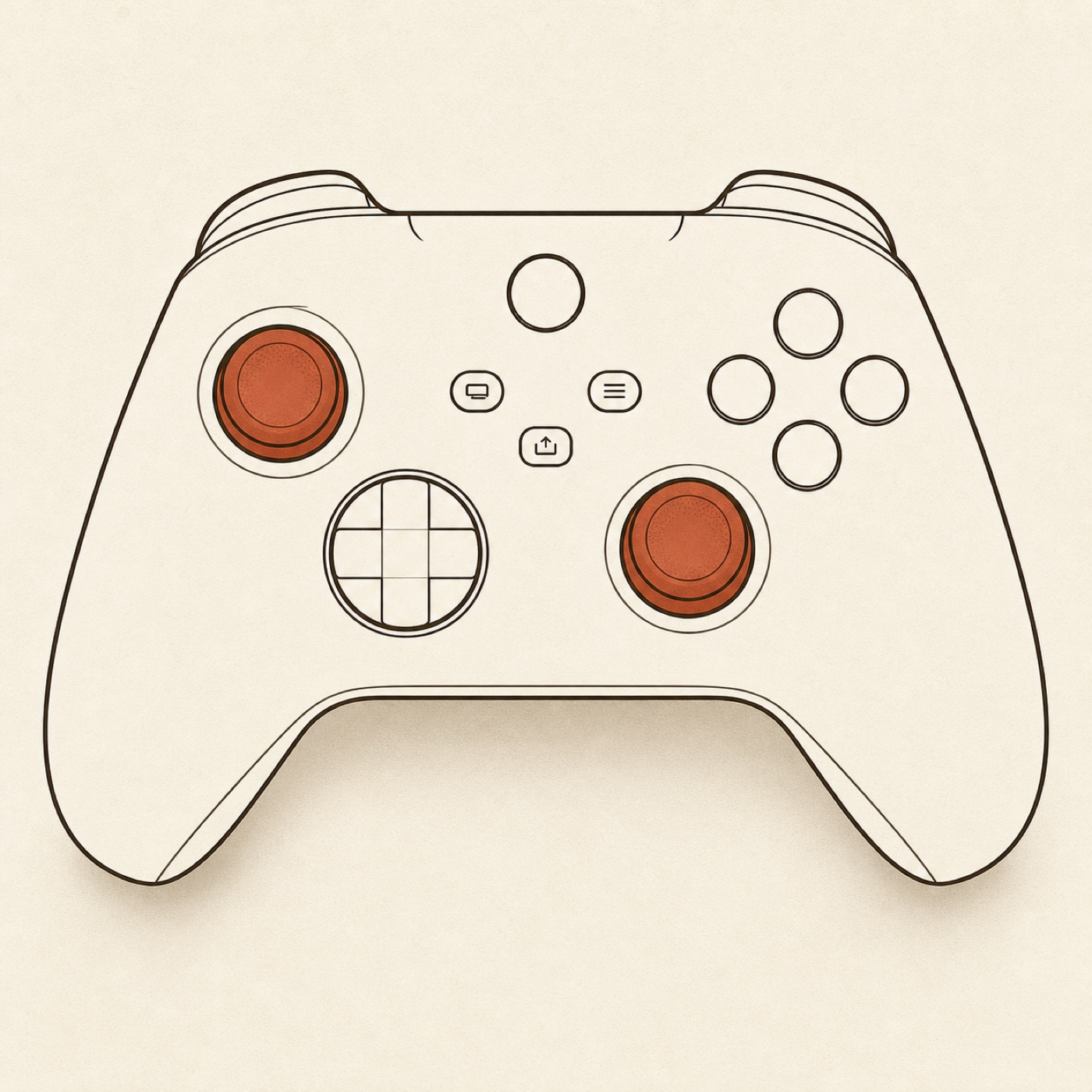
The diagram above is an Xbox pad, not a generic controller with the wrong labels stuck on it. Press A and the A zone lights up.
Impulse triggers
An Xbox One or Series pad has four rumble motors, not two. Two sit in the grips. The other two sit inside LT and RT, and they are what makes a trigger kick back when a gun fires or a wheel loses grip. They are known as impulse triggers.
Normally it reads the name and the vendor id the controller reports. On macOS that can fail: the Series X|S pad we measured introduced itself as nothing more useful than "Controller (STANDARD GAMEPAD)", with no vendor id in the string at all. We measured that on a real pad.
Impulse triggers are the way around it. Chromium-based browsers only offer the trigger-rumble effect for controllers on a static allowlist they ship internally, and every entry on that list is a Microsoft product. So a pad announcing trigger-rumble has told you who made it, whatever its name says.
This works in one direction only, and it would be easy to quietly get wrong. Announcing trigger-rumble proves an Xbox pad. Not announcing it proves nothing at all: an Xbox 360 controller has no trigger motors, nor does a Switch Pro pad, nor do most third-party controllers. If the panel above says your pad announces nothing, that is a statement about trigger motors and not about who made your controller.
A browser can start a rumble effect and never hear back from it. The call can report itself as complete while nothing at all has moved: we measured exactly that on an Xbox pad connected over USB on macOS, both effects announced and the controller completely still. That is why this page has no green "your impulse triggers work" badge for you to screenshot.
The likely reason is not the operating system, which is the answer most sites give. It is the connection. The engineer who added Xbox haptic support to Chromium on macOS noted that they verified it over Bluetooth and could not get a wired connection working, which matches our wired pad exactly. And the Gamepad interface has no field for how a controller is connected, so this page cannot know which case you are in, and it does not guess.
What it does instead is the honest version: it fires a real impulse effect at one trigger at a time, and asks you what you felt. Your answer is the result. If both triggers stay silent on a wired pad, try it over Bluetooth before you conclude anything about the hardware.
Stick drift
Drift is when a stick sends input while you are not touching it — the camera creeps, the character wanders off. It is one of the most common Xbox controller faults, and one of the easiearched Xbox controller complaint there is, and because the cause is mechanical wear, an offset does not tend to fix itself.
The tester above flags a stick that is not resting cleanly. If that hint appears, or a stick already feels wrong in games, the stick drift test is the tool for it: it samples each stick at rest and returns a straight PASS, DRIFTING or FAIL with the measured offset. Work the fixes cheapest-first: recalibrate, raise the deadzone, clean around the stick base, and replace last.
Troubleshooting
When an Xbox controller will not work on a computer, these five are the usual places to look.
Testing a different pad? The general controller test adapts to whatever you connect.
FAQ
The short answers. The tool above and the sections on this page cover the rest.
Yes. No sign-up, no download, no extension. Connect the controller, press a button, and each input lights up as you try it — every one your browser is allowed to read.
Plug the pad in over USB or pair it over Bluetooth, then press any button so the browser can see it. The diagram lights up as you work through the buttons, triggers and sticks. Anything still dark is worth chasing. Then let go of both sticks and press Run drift test.
Because that is all your browser was told: on macOS a Series X|S pad can introduce itself as nothing more than "Controller (STANDARD GAMEPAD)", with no vendor id at all — that is what we measured on ours. This page has a second route. If the pad announces impulse-trigger support, that is a capability Chromium-based browsers (Chrome, Edge) only offer for controllers on their own Xbox allowlist, so the announcement identifies the pad when the name cannot.
It can test them the only honest way a browser can. The page reads whether your pad announces the trigger-rumble effect and reports that as an announcement, then fires real impulse effects at each trigger and asks what you felt. What it will never do is tell you your trigger motors work: the browser starts an effect and gets no report back. Worth knowing before you judge your own pad: the browser code that drives Xbox rumble on macOS was verified over Bluetooth only, and its author recorded that they could not get a wired connection working. A wired pad that announces impulse triggers and then sits still is a documented case, not proof of a broken motor.
Two different reasons that happen to look the same. Your operating system claims the Xbox button before any website can see it. Share is a separate case: on macOS it is not mapped through to the browser at all, so there is nothing to read. A dimmed button here is expected, not a fault in your pad.
Xbox One and Series X|S: yes, for everything the browser exposes — both send the same standard layout, so the face buttons, D-pad, bumpers, analog triggers and both sticks read correctly. An Xbox 360 pad is a different case and we have not tested one: it needs a driver your system may not have, and on macOS in particular a wired 360 controller often never reaches the browser at all. If yours does appear, the same standard layout applies. Impulse triggers arrived with the Xbox One pad, so a 360 controller has no trigger motors to announce and that walk stays closed for it.
Both work for testing buttons, sticks and triggers, and USB is the steadier for a first pass. Rumble is the one place they can differ, and this page cannot tell you which you are on: the Gamepad API exposes no transport field, so no browser can. If the rumble walks find nothing, try the other connection before concluding anything about the hardware.
That points at software, not the pad. If every input reads correctly here, the controller is sending what it should and the problem is downstream: the game’s input settings, a missing profile, or a layer like Steam Input intercepting it.
This Xbox controller test shows what your sticks are doing right now, and Run drift test flags one that is not resting clean. For an actual verdict, run the dedicated stick drift test, which grades each stick against a fixed threshold. Try the free fixes first either way: recalibrate, raise the deadzone, then clean around the stick base.
No. The test runs entirely in your browser through the Gamepad API. Nothing about your controller, and nothing you press, leaves your device.
More controller tests
The same engine, adapting to whatever you connect — Xbox, PlayStation and more.
A straight PASS / DRIFTING / FAIL on each stick, with the measured resting offset.
The same handle-rumble walk this page runs, for any controller your browser can buzz.
The same engine, locked to a DualSense — every shape, the analog triggers and the touchpad click.
This page shows what your Xbox controller is doing. The stick drift test grades it.
Run the stick drift test